Peptide Screening: Hplc & Mass Spec Pureness Guide Pinnacle
Acs Peptide Testing Labs Third-party Peptide Analysis
Discover our magazine to see validated research substances and find out more about our screening and quality control procedure. Also small pollutants can change outcomes, reduce reproducibility, or introduce undesirable variables into a research. Researchers rely on exact, verified compounds to ensure their findings are both valid and consistent." Mass spectrometry responses "is the detected compound consistent with the desired peptide identity? " With each other they supply more powerful batch-level proof than either method alone. In the typical peptide COA context, peak purity typically refers to the portion of total chromatogram location represented by the main peptide top.
These can be especially bothersome since their chromatographic habits is extremely similar to the target peptide, making them tougher to separate throughout filtration. When a peptide is 98% pure, that remaining 2% isn't random noise-- it's specific, identifiable sorts of by-products. Mass spectrometry determines the molecular weight of a compound with severe precision. For peptides, one of the most common methods are electrospray ionization (ESI-MS) and matrix-assisted laser desorption/ionization time-of-flight (MALDI-TOF). HPLC separates a blend right into its private parts based upon how each particle connects with a particularly developed column.- The key is recognizing what degree of purity is sufficient for your demands and just how pureness is established to begin with.
- For a 10-residue peptide with 99.5% combining efficiency, you would certainly expect about 95% of the end product to be the unabridged series before filtration.
- The software program draws limits around each optimal and determines the location beneath.
- A recognized lab complies with stringent guidelines for examination accuracy and method validation.
- With our comprehensive peptide evaluation platform, Creative Proteomics has developed a highly delicate and specific platform.
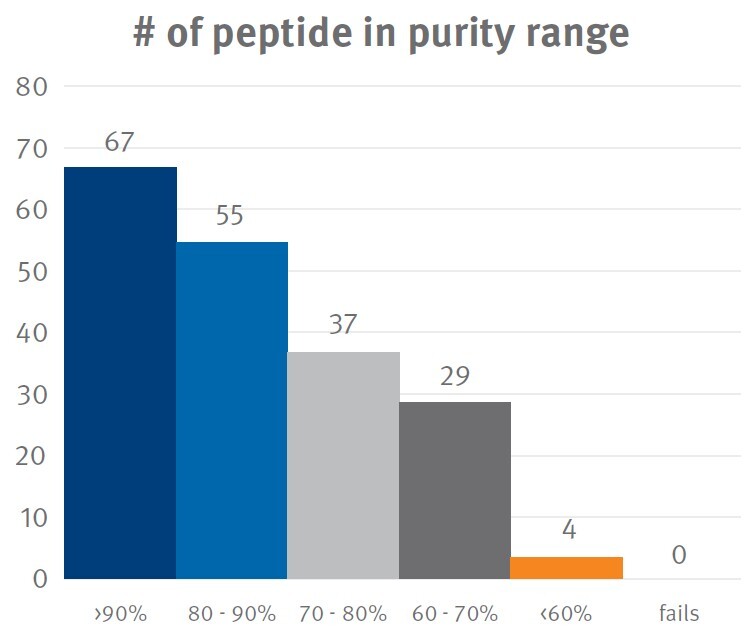
Together, these logical methods give the proof base for wrapping up that a peptide batch appropriates for research study use. Another related term you may encounter is web peptide content, which is different from purity. Web peptide material refers to how much real peptide (by weight) remains in the vial about Amino Acid Chains non-peptide components like water, counter-ions (e.g., TFA), Research Compounds or buffer salts.
Residuals Testing
Creative Proteomics is a relied on company of proteomics evaluation services. Thanks to our impressive researchers and powerful mass spectrometry system, we off offers worldwide client with thorough and specialist peptide pureness evaluation solution by utilizing RP-HPLC. If you have any type of concerns or particular requirements, please feel free to call us.Suggested Tests By Analytical Goal
Very few industrial research study peptide vendors offer MS/MS information on routine COAs-- it is usually scheduled for pharmaceutical-grade products and advanced research study settings. However, some premium suppliers do give it on ask for important sets. If series verification is important for your research, this is the evaluation to request. It separates the elements of an example based upon their differential affinity for a stationary stage (column packing product) and a mobile stage (solvent system relocating via the column). Peptides, with long molecular sequences and varied conformations, present challenges for framework verification and content decision. BOC Sciences leverages high-resolution mass spectrometry, LC-MS/MS, and NMR to precisely assess molecular structures and provide very sensitive quantitative support. 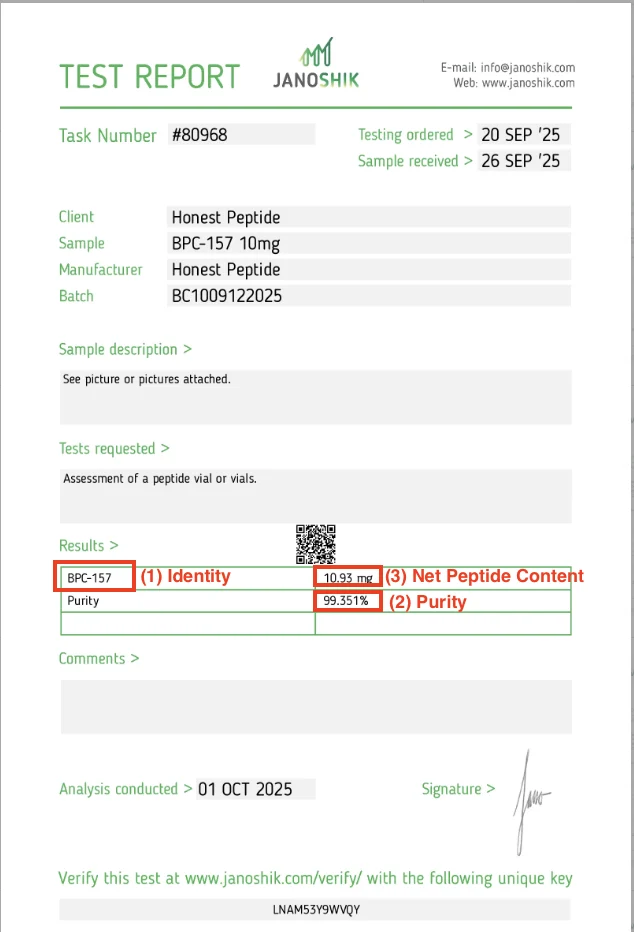
HPLC actions chromatographic pureness by separating the target peptide from associated contaminations and computing main-peak area percent. Mass spectrometry verifies molecular identity by checking whether the measured mass matches the expected peptide mass. For research-grade peptide qualification, HPLC and LC-MS/ESI-MS solution different concerns and must be read with each other. BOC Sciences likewise supplies detailed artificial insemination (cell platforms) and in vivo (animal systems) testing solutions to aid clients completely understand peptide solution performance in different environments. Artificial insemination examinations examine peptide cytotoxicity, cell uptake, anti-inflammatory task, and more, offering basic data support for peptide applications in clinical looks and biomedical areas.
The gold standard for determining peptide pureness is high-performance fluid chromatography, generally abbreviated as HPLC. If you see a purity percent on a peptide item, it almost certainly originated from an HPLC evaluation. This matters since peptides are developed one amino acid at a time via solid-phase peptide synthesis (SPPS). At each step, there's a tiny possibility that something goes wrong-- an amino acid doesn't connect, the wrong modification takes place, or a side reaction produces an unplanned by-product. Over a chain of 10, 20, or 40 amino acids, those small per-step error rates compound. HPLC tells you what percentage of your example is the major substance-- however it does not confirm what that primary substance really is. A peak with the appropriate retention time can in theory be a relevant peptide with similar hydrophobicity. Mass spectrometry gives identity confirmation by measuring molecular mass straight. We assess peptide length, series make-up, anticipated molecular weight, modification kind, salt kind, sample history, and intended downstream use before specifying the analytical path.